


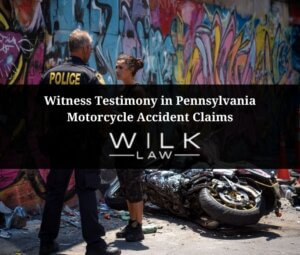
 Witness testimony in motorcycle accident claims in Pennsylvania consists of firsthand accounts from people who saw your crash happen. These statements can be crucial for proving fault and protecting your right to compensation.
Under Pennsylvania’s modified comparative negligence law, your ability to recover damages depends on how fault is allocated, making credible witness accounts essential for establishing liability and countering insurance company attempts to shift blame.
Motorcycle riders face unique challenges in Pennsylvania claims, including insurance bias that assumes riders caused crashes, a lack of Personal Injury Protection coverage that car drivers have, and the need to prove fault under comparative negligence rules.
Witness testimony is powerful evidence as it provides independent verification of what actually happened, supporting your version of events with unbiased observations that insurance adjusters and courts find credible.
Who Qualifies as a Credible Witness in a Motorcycle Crash
Anyone who observed your accident can serve as a witness, including other drivers, pedestrians, passengers, and nearby workers. First responders, such as police officers and EMTs, can also testify about what they saw immediately after the crash.
A credible witness has a clear view of the accident, tells a consistent story, and has no personal stake in the outcome. Their testimony is most powerful when it aligns with the physical evidence at the scene, such as vehicle damage and skid marks.
Eyewitnesses Versus Passenger Witnesses
Eyewitnesses, such as uninvolved bystanders or other drivers, are often considered highly credible because they have no relationship to anyone involved. Their neutral perspective carries significant weight with insurance adjusters and juries.
Passenger witnesses may face questions about their objectivity because of their connection to the driver. However, their testimony remains valuable when it’s detailed and matches other evidence. Our experienced Philadelphia motorcycle accident lawyers know how to present passenger testimony effectively by highlighting its consistency with the facts.
Expert Witnesses in Motorcycle Accident Reconstruction
Expert witnesses become essential when fault is disputed or there are no eyewitnesses. Accident reconstruction specialists are engineers who analyze crashes using physical evidence like damage patterns, skid marks, and debris fields to determine how the collision occurred.
Medical experts explain how the crash forces caused your specific injuries, linking the other driver’s negligence directly to your harm. These professionals provide objective, data-driven opinions that can be critical in proving your case when human witnesses aren’t available.
How Witnesses Help Prove Fault Under Pennsylvania’s Comparative Negligence
Witnesses prove fault by confirming specific details about the other driver’s actions before the crash. They can testify that the driver was speeding, ran a red light, made an illegal lane change, or was following too closely. These observations become the foundation of your negligence claim.
Under Pennsylvania’s comparative negligence system, witness observations translate into fault percentages that determine your compensation. For example, if a witness confirms that a car turned left into your path while you had the right-of-way, their testimony can establish that the other driver was 100% at fault.
Witness testimony protects your financial recovery by creating a factual record that counters attempts to blame you.
Insurance companies and defense attorneys often try to shift fault onto motorcyclists, making independent corroboration of the other driver’s negligence invaluable.
Where to Find Witnesses and Evidence After a Motorcycle Crash
Time is critical after a motorcycle crash because evidence can be lost quickly; witnesses may forget details, and business surveillance recordings can be overwritten if not preserved promptly. If you’re physically able, gather contact information from anyone who saw the accident immediately.
If your injuries require hospital transport, ask a trusted friend or family member to act on your behalf. The faster someone can secure witness information and request evidence preservation, the stronger your claim will be.
People at the Scene and Nearby
Look for potential witnesses in these locations:
- Other drivers who stopped to help
- Pedestrians walking or waiting at bus stops
- Cyclists or joggers in the area
- Residents who heard the crash and came outside
- Workers from nearby businesses
These individuals may have seen the moments before impact, witnessed a traffic violation, or heard the other driver admit, “I’m sorry, I didn’t see you.”
Our legal team at Wilk Law Personal Injury & Car Accident Lawyers can use investigative resources to track down witnesses you missed in the initial chaos.
Businesses, Cameras, and Digital Footage
Video evidence provides powerful, unbiased testimony. Look for cameras at gas stations, retail stores, banks, traffic lights, and on residential doorbells.
Many motorcyclists now use helmet cameras or GoPros that capture first-person footage of the crash, and understanding Pennsylvania’s motorcycle helmet laws helps ensure both safety compliance and evidence preservation.
You must act immediately to preserve this footage. Visit or call these locations right away to request that they save the video from the time of your accident. Because surveillance footage can be deleted quickly, take immediate steps to preserve any video evidence.
First Responders and Official Reports
Police officers create accident reports that often include witness names and contact information. EMTs and paramedics document your injuries and sometimes overhear important statements from those involved in the crash.
Additionally, 911 call recordings establish timelines and capture callers’ initial reactions. A Pennsylvania motorcycle accident lawyer can formally request all these official reports and recordings to support your case.
What to Ask a Motorcycle Accident Witness
Ask open-ended questions that let witnesses describe what they saw in their own words. Avoid suggesting what might have happened or asking for opinions about fault. Even well-meaning witnesses can be influenced by how you phrase questions.
Stick to factual “who, what, when, where, and how” questions to capture the most accurate details. Leading questions can make witness testimony less credible and potentially harmful to your case.
Essential Questions to Lock in Details
Here are key questions to ask any witness:
- Where were you positioned and what could you see clearly?
- What first drew your attention to the vehicles?
- Can you describe each vehicle’s actions before impact?
- Did either vehicle violate traffic signals or signs?
- How fast was each vehicle traveling?
- Did you hear braking, horns, or engine acceleration?
- What were road and weather conditions?
- Did you see or hear either driver after the crash?
- Were there any obstructions affecting visibility?
- Did anyone appear distracted or impaired?
- Can you describe the impact and vehicle positions afterward?
- Did you notice if the motorcyclist wore protective gear?
- Did anyone take photos or video?
- Do you know other witnesses?
- May we contact you for a written statement?
How to Preserve and Present Witness Statements in Pennsylvania
Witness accounts must be formally preserved to be admissible in legal claims. Affidavits are written statements that witnesses sign under oath, confirming their truthfulness. Depositions are formal question-and-answer sessions recorded by court reporters during litigation.
Timing matters significantly. Affidavits can be secured immediately while memories are fresh, but depositions typically occur months later. Consistency across all statements strengthens credibility and makes testimony more persuasive.
Affidavits, Recorded Statements, and Depositions
Affidavits capture witness memories while they’re still clear and detailed. Audio or video recordings can also be effective but require clear consent from the witness. Depositions create official court records and allow attorneys to ask detailed follow-up questions under oath.
The key is consistency across all statements from initial scene comments to formal depositions. Our attorneys help prepare witnesses to ensure their testimony is presented clearly and accurately without coaching them to change their accounts.
Avoiding Insurance Company Tactics
The other driver’s insurance company may contact witnesses before you do. Their adjusters ask leading questions designed to minimize the driver’s fault or create doubt about what witnesses actually saw. These recorded statements can then be used against your claim.
Witnesses should speak with their attorney before giving any statement to insurance companies. We ensure their accounts are recorded accurately and completely, without pressure or manipulation from adjusters whose goal is to protect their company’s profits.
What if There Are No Eyewitnesses to Your Motorcycle Crash
Cases can succeed without eyewitnesses using physical evidence, expert analysis, and circumstantial proof. Pennsylvania courts regularly decide cases based on forensic reconstruction and evidence patterns that tell a clear story of what happened.
The focus shifts to different types of evidence that can be just as persuasive as human testimony. Physical evidence often provides more reliable information than human memory, which can be imperfect or influenced by emotions.
Forensic Reconstruction and Physical Evidence
Physical evidence becomes your primary witness when humans aren’t available:
- Skid marks: Show braking patterns and vehicle speeds
- Gouge marks: Indicate exact impact points on the pavement
- Vehicle damage: Reveals collision angles and force
- Debris patterns: Show direction of travel after impact
Accident reconstructionists use physics formulas to calculate speeds and movements from this evidence. Your motorcycle damage, protective gear condition, and injury patterns also help reconstruct exactly how the crash occurred.
Act Fast to Preserve Time-Sensitive Proof
Pennsylvania’s statute of limitations limits the time to file a lawsuit, and some crucial evidence can be lost quickly. Surveillance footage can be deleted quickly, and physical evidence may be cleaned up or washed away by the weather.
Our attorneys can immediately send preservation letters demanding that businesses preserve relevant evidence, such as video footage. Acting within days, not months or years, is crucial for preserving the strongest possible case.
What Other Evidence Strengthens a Motorcycle Injury Claim
Strong personal injury claims combine multiple types of proof that support each other. Witness testimony becomes more powerful when corroborated by physical evidence and detailed documentation of your damages.
Visual proof and comprehensive records create a compelling picture of both the other driver’s fault and the full extent of your losses. This combination makes it harder for insurance companies to dispute your claim.
Photos, Gear Damage, and Medical Records
Take photos of your motorcycle’s damage from multiple angles, the other vehicle, road conditions, traffic signs, and your injuries over time. Your damaged helmet, jacket, and boots demonstrate the impact’s severity and support witness accounts of the crash’s violence.
Medical records connect your injuries directly to the crash. Include emergency room reports, surgical notes, diagnostic tests, prescription records, and physical therapy documentation. These records prove both the extent of your injuries and their connection to the accident.
Lost Wages and Pain Documentation
Document your economic losses with pay stubs from before the accident, employer letters confirming missed work, and tax returns if you’re self-employed. This proof supports your claim for lost income and reduced earning capacity.
Keep a daily pain journal describing your physical limitations, missed activities, and emotional impact. These personal accounts humanize your claim beyond medical terminology and help demonstrate non-economic damages like pain and suffering.
Knowledgeable Pennsylvania Motorcycle Crash Law Firm
We understand the unique challenges motorcycle accident victims face in Pennsylvania, including insurance company bias and complex fault determinations. Our team acts immediately to locate witnesses and preserve time-sensitive evidence, such as video footage, before it disappears forever.
We work with trusted accident reconstruction experts and medical professionals who understand motorcycle crash dynamics. Our motorcycle accident lawyers serve clients throughout West Chester, Reading, Allentown, Coatesville, Pottstown, and across Pennsylvania with the compassionate yet aggressive advocacy you deserve.
You shouldn’t worry about legal fees while recovering from serious injuries. We work on a contingency fee basis, meaning you pay nothing unless we win your case. Your initial consultation is always free, so contact us today to learn how we can help you pursue the justice and compensation you deserve.
Frequently Asked Questions
Can a Passenger Serve as a Witness in Pennsylvania?
Yes, passengers can testify about the crash, though insurance companies may question their objectivity due to their relationship with the driver. Their testimony gains credibility when it aligns with physical evidence and other witness accounts.
Do I Need an Expert Witness for a Motorcycle Accident Case?
Expert witnesses become crucial when there are no eyewitnesses, when accounts conflict, or when crash dynamics are complex. Accident reconstructionists and medical experts provide technical analysis that helps establish fault and prove the severity of injury.
Will My GoPro or Dashcam Footage Count as Witness Evidence?
Yes, video footage serves as powerful evidence, essentially acting as an unbiased electronic witness, and dashcam footage can strengthen your claim by providing irrefutable documentation of the incident. Preserve original files immediately and provide copies to your attorney, maintaining timestamps and GPS data when available.
Should I Share Witness Names with the Insurance Adjuster?
Consult your attorney before sharing witness information with insurance adjusters. We coordinate witness contact to prevent coaching, pressure tactics, or out-of-context statements that could harm your claim.
How Long Do I Have to File a Pennsylvania Motorcycle Accident Lawsuit?
Pennsylvania’s statute of limitations is generally 2 years from the date of the crash. However, evidence preservation requires immediate action, as witnesses disappear and footage is deleted within days, making a quick legal consultation critical.
What Does It Cost to Hire Wilk Law?
We work on a contingency fee basis, meaning no payment unless we win your case. Initial consultations are free, and we advance case costs when appropriate, removing financial barriers to quality legal representation.