

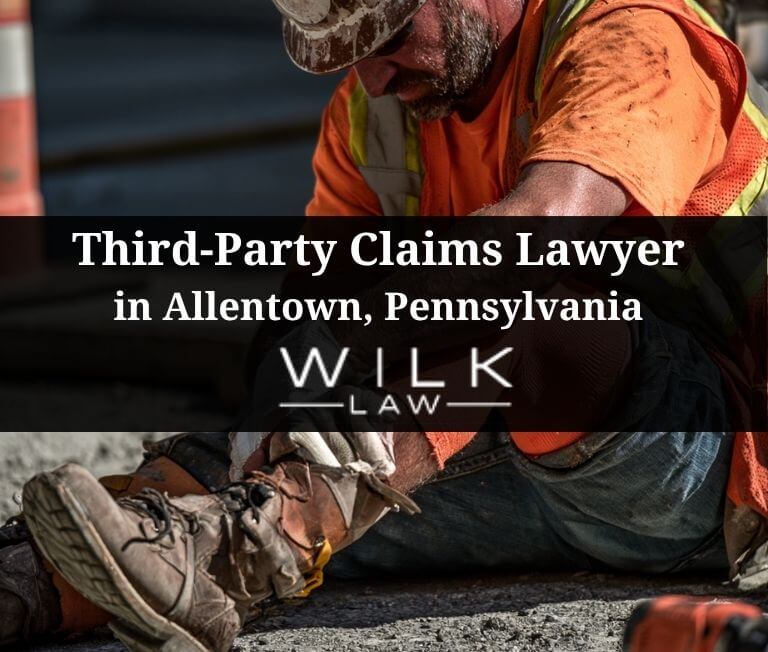
Injured in a workplace accident caused by someone else’s negligence in Allentown, Pennsylvania? Our experienced third-party claims lawyers in Allentown, Pennsylvania will help you to seek justice and compensation.
When your injury happened on the job, workers’ compensation covers only a fraction of what you have lost, and it pays nothing for your pain and suffering.
If a party outside your employer, a subcontractor, a driver, a property owner, or a manufacturer, contributed to the accident, you may have a separate claim for full compensation. Insurance companies representing that third party will look for any reason to minimize or deny what they owe you.
Wilk Law Personal Injury & Car Accident Lawyers represents injured workers and accident victims across Allentown, Bethlehem, Easton, and the Lehigh Valley who deserve more than a workers’ comp check. Founded by Tyler J. Wilk, our Allentown third-party claims lawyers investigate every party whose negligence contributed to your injury, negotiates your workers’ comp lien down, and builds the strongest possible third-party claim on your behalf.
Contact us today for a free consultation.
Why Hire a Third-Party Claims Lawyer in Allentown?
After a serious injury, most people assume their only options are workers’ compensation or a claim against their own auto insurance. A third-party claim is a legal action against the person, company, or entity whose negligence actually caused your harm, and it unlocks compensation that workers’ comp and first-party insurance simply cannot provide.
At Wilk Law, we fight for injured people across Allentown and the Lehigh Valley who deserve every dollar the law allows. Our founder, Tyler J. Wilk, built this firm on a single conviction: that injured people deserve aggressive representation, not a quick payout from an adjuster working for the other side.
What Is a Third-Party Claim in Pennsylvania?
A third-party claim is a personal injury lawsuit filed against someone other than your employer or your own insurer. It works alongside, not instead of, any workers’ compensation or first-party insurance claim you may already have open.
Here is why the distinction matters: workers’ comp pays your medical bills and a portion of your lost wages, but it stops there. A third-party claim allows you to pursue pain and suffering, full lost wages, and every other category of harm that workers’ comp leaves behind.
Common third-party claim scenarios include:
- A construction worker injured because a subcontractor ignored safety regulations
- A delivery driver hurt in a crash caused by a distracted motorist
- A warehouse employee injured by a defective piece of heavy equipment
Who Can You Sue in a Third-Party Claim?
We investigate every aspect of your case to identify every party whose negligence contributed to your injury. Depending on how your accident occurred, you may have a valid claim against one or more of the following:
A pattern our Allentown third-party claims lawyers consistently see in Lehigh Valley third-party claims is that more than one company shares responsibility for a single jobsite or delivery route, and an insurer will not point that out voluntarily.
We pull subcontractor agreements and delivery logs early in every case, because a second or third liable party often exists even when the initial accident report names only one driver.
General Contractors and Subcontractors
General contractors and subcontractors on Allentown job sites are legally required to maintain safe working conditions. When they ignore that obligation and someone gets hurt, they are accountable for every consequence that follows.
Property and Business Owners
Property owners and businesses have a duty to keep their premises reasonably safe. If a dangerous condition, a wet floor, broken steps, or poor lighting, caused your injury, we hold the owner responsible for the full scope of your losses.
Drivers and Commercial Carriers
When an at-fault driver operates a commercial truck, rideshare vehicle, or delivery van, the company behind them may share direct liability for your injuries. We pursue claims against both the individual driver and the company that employed them.
Product and Equipment Manufacturers
If a defective tool, machine, or vehicle part caused your injury, Pennsylvania law gives you a strict liability claim against the manufacturer. You do not have to prove the manufacturer was negligent, only that the product was defective and that defect caused your harm.
Government Entities
You can sue a government body in Pennsylvania, but the rules are strict and the deadlines are short. Missing the required notice deadline permanently eliminates your right to recover, which is why contacting us right away matters.
How Workers’ Comp and Third-Party Claims Work Together
Many injured workers do not realize they can file both claims at the same time, and that is often one of the most valuable things we tell a new client. Workers’ comp is your floor, not your ceiling. When a third party’s negligence contributed to your workplace injury, you have every right to pursue both.
What our Allentown workplace injury lawyers see repeatedly in workers’ comp and third-party cases is that injured workers are told by an adjuster that filing both claims is not allowed, when Pennsylvania law permits exactly that. We walk clients through both tracks from the first call, because waiting to explore the third-party side often means evidence at the jobsite or crash scene disappears before it can be preserved.
What Is a Workers’ Compensation Lien?
When your comp carrier pays your medical bills and wage loss benefits, it earns a legal right to be repaid from any third-party settlement you receive. This reimbursement right is called a workers’ compensation lien, and managing it correctly can be just as valuable as winning the third-party claim itself.
How We Negotiate Your Lien
We negotiate directly with the comp carrier to reduce the lien, which keeps more of your settlement in your pocket instead of the insurance company’s.
- Gross Recovery: The total amount the negligent third party pays to resolve your claim.
- Lien Reimbursement: The share owed back to the comp carrier, an amount we aggressively negotiate down before any settlement is finalized.
- Attorney Share of the Lien: Pennsylvania law requires the carrier to contribute proportionally to your attorney’s fees, further reducing what you owe.
- Future Credit: We structure settlements to limit how your recovery offsets future workers’ comp benefits you may still need.
What Compensation Can You Recover?
A third-party claim is your opportunity to be made whole, not just partially compensated. We pursue every category of loss you have suffered.
Economic Losses
Economic damages cover past and future medical expenses, the full value of lost wages, not just a fraction, reduced earning capacity, and property damage. A third-party claim can allow you to pursue full lost wages, whereas workers’ compensation generally provides more limited wage benefits.
Pain and Suffering
Workers’ compensation does not pay for pain and suffering, but a third-party claim does. You can recover for physical pain, emotional distress, anxiety, sleep loss, and every way your injury has permanently changed how you live, losses the insurance company will never volunteer to pay.
Punitive Damages and Wrongful Death
When a defendant’s conduct was especially reckless, a company that hid a known safety defect, a driver operating with a suspended license, we pursue punitive damages to hold them accountable beyond your actual losses. If you have lost a loved one due to negligence, we file wrongful death and survival actions to secure justice and your family’s financial future.
How Long Do You Have to File in Pennsylvania?
In Pennsylvania, you generally have two years to file a personal injury lawsuit from the date of your injury. That deadline can move faster than you expect, surveillance footage gets overwritten, witnesses relocate, and physical evidence disappears. We recommend reaching out as soon as possible, because the earlier we get involved, the more we can preserve.
Government Claims: Special Deadlines and Caps
If a government entity may be responsible for your injury, special notice requirements and shorter filing deadlines can apply, so contact an attorney promptly to protect your rights. Pennsylvania also limits damages against local government, making early legal counsel essential.
How Third-Party Auto Claims Work after an Allentown Crash
Pennsylvania’s auto insurance system is unlike most states, and those rules directly shape how your third-party claim plays out after a collision in Allentown or anywhere in the Lehigh Valley.
Your own policy’s Personal Injury Protection benefits, called PIP, pay your medical bills first regardless of who was at fault. Once those limits run out, we pursue the at-fault driver’s bodily injury liability coverage for remaining medical costs, full wage loss, and pain and suffering.
Limited Tort Exceptions in Pennsylvania
If you selected limited tort on your policy, you can still recover for pain and suffering when any of these exceptions apply:
- You suffered a serious impairment of a body function
- The at-fault driver was under the influence of alcohol or drugs
- The at-fault vehicle was a commercial vehicle or bus
- The at-fault driver was uninsured or licensed in another state
UM/UIM Coverage and Stacking
When the at-fault driver carries no insurance or not enough to cover your losses, we file a claim through your own Uninsured Motorist or Underinsured Motorist coverage. If you paid for stacking, a Pennsylvania option that multiplies coverage across every vehicle on your policy, we ensure you benefit from every dollar of protection you purchased.
How Much Is Your Third-Party Case Worth?
The value of your claim depends on liability strength, injury severity, available insurance limits, and the long-term impact on your income and quality of life. The table below shows what each type of claim allows you to recover:
| Claim Type | Medical Bills | Lost Wages | Pain & Suffering | Punitive Damages |
| Workers’ Comp Only | Covered | Partial | Not Available | Not Available |
| Third-Party Claim | Full Recovery | Full Recovery | Available | Available |
We have secured substantial recoveries for pedestrians and cyclists, outcomes built on thorough preparation and advocacy that insurance companies take seriously. Every case is unique, but those results reflect the standard we hold ourselves to for every client we represent.
How We Build Your Case
We treat every case as trial-ready from the first call. Insurance companies offer more when they know we are fully prepared to take them to court.
- Free Consultation: We evaluate your case, answer every question, and explain your legal options with no obligation.
- Immediate Investigation: We secure surveillance footage, witness statements, black box data, and maintenance records before anything is lost.
- Preservation Letters: We put all parties on legal notice to preserve critical evidence the moment you hire us.
- Demand and Negotiation: We document every loss and fight the insurers for a full and fair settlement.
- Trial Preparation: When an insurance company refuses to pay what your case is worth, we file suit and see it through in court.
In our experience building third-party claims out of Lehigh County, insurance adjusters routinely make an early settlement offer before a client has finished treatment, hoping to lock in a number before the full scope of the injury is known. We hold every claim open until a treating physician documents the complete course of care, so an incomplete medical record never becomes the ceiling on what a client recovers.
Skilled Workplace Injury Law Firm in Allentown, Pennsylvania
You pay nothing to hire us and nothing out of pocket throughout your case. We work on a contingency fee basis, our fee is a percentage of what we recover, and we collect it only when we win. We advance all case costs, including expert witnesses, investigation fees, and medical records, so your financial situation never determines the quality of your representation.
Our team is available around the clock, every day of the week. We serve clients across Allentown, Bethlehem, Easton, and the Lehigh Valley, and we come to you, at home or in the hospital, when you need us most.
Call (855) 946-3678 or request your free case evaluation, available 24/7.
Frequently Asked Questions About Third-Party Claims in Allentown
Can I Pursue a Third-Party Lawsuit While Receiving Workers’ Comp in Pennsylvania?
Yes. Pennsylvania law allows you to collect workers’ comp benefits and pursue a separate third-party lawsuit at the same time, the two claims are entirely independent of each other.
Can I Sue My Employer for a Workplace Injury?
In most cases, no. Pennsylvania’s Workers’ Compensation Act makes workers’ compensation your exclusive remedy against your employer, with narrow exceptions for cases where your employer caused deliberate, intentional harm.
How Does a Workers’ Comp Lien Affect My Third-Party Settlement?
We negotiate the lien down before your settlement is finalized, and the carrier is required by law to absorb a proportional share of your attorney’s fees, both of which reduce the balance you owe.
What If the At-Fault Driver Is Uninsured or Underinsured?
We file a UM or UIM claim through your own policy and pursue every other available liable party so you are not left absorbing losses caused entirely by someone else’s negligence.
Does Limited Tort Selection Prevent Me from Suing for Pain and Suffering?
Not necessarily. Pennsylvania law provides multiple exceptions that allow limited tort policyholders to recover for pain and suffering, especially when the injury is serious or a commercial vehicle was involved.
What Should I Do Right After an Injury to Protect My Third-Party Claim?
Get medical care immediately, document the scene if you are able, and contact an attorney before giving any statement to an insurance company, early mistakes are the hardest to fix.