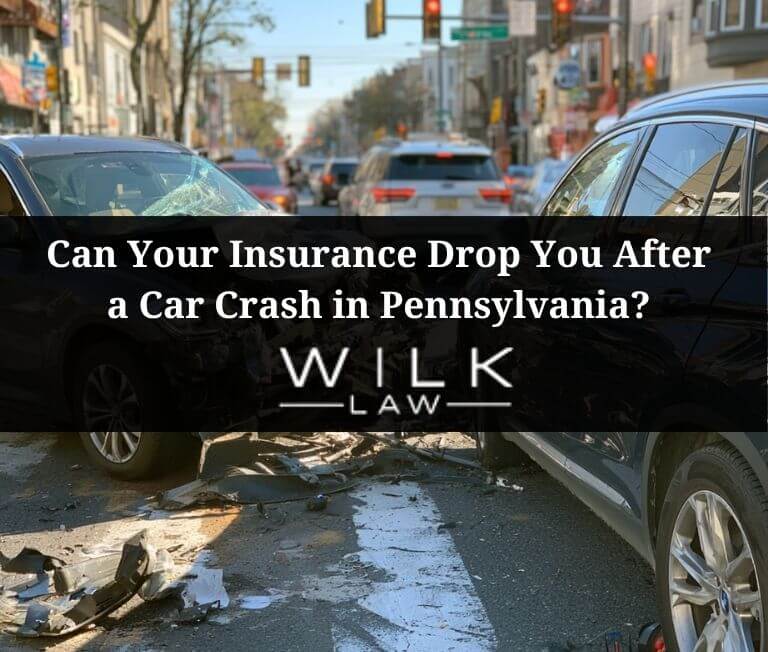


A car accident in Pennsylvania can raise your insurance rates, trigger a fault dispute, and change what your policy covers for months or years afterward.
Pennsylvania operates under a choice no-fault system, which means your own Personal Injury Protection (PIP) coverage pays your medical bills after a crash, regardless of who caused it. Whether your premiums increase after that depends on who is found at fault and the specific coverage options you selected when you bought your policy.
Your insurer does not wait for a court ruling. They conduct their own internal investigation, and their conclusion, not a judge’s, determines whether your rates change at renewal.
Will Your Insurance Rates Go Up After a Pennsylvania Crash?
A rate increase is common after an accident, but not automatic. Insurance companies decide whether to apply a surcharge, an added charge to your premium at renewal, based on their assessment of how risky you are to insure going forward.
The factors that most influence the decision include:
- Fault determination: An at-fault label is the primary trigger for a rate hike. Your insurer uses it as evidence that you are more likely to generate costly claims in the future.
- Claim payout size: The larger the payout for injuries or property damage, the more justification your insurer has to raise your rates.
- Prior driving record: A clean history before the accident can reduce the severity of a surcharge, even when fault is assigned.
- Accident forgiveness: Some policies include a one-time provision that waives a rate increase after your first at-fault crash. This is not standard. Check whether your policy includes it.
If you were not at fault and the evidence supports that, you may avoid a rate increase entirely.
Does the Type of Claim You File Affect Your Rates?
The coverage you file through matters just as much as the accident itself. Filing through your liability coverage after an at-fault crash will almost always result in a surcharge, but filing because another driver hit you typically will not.
| Claim Type | Raises Rates? | Why |
| Liability (At-Fault) | Yes | Directly signals you caused the accident |
| PIP (Medical Benefits) | Sometimes | Repeated PIP claims over time can flag you as higher risk |
| Collision (At-Fault) | Yes | Treated the same as a liability surcharge |
| Uninsured/Underinsured Motorist | Usually No | You were the victim, so no fault is assigned to you |
| Comprehensive | Rarely | Covers theft, weather damage, and non-collision events |
If the at-fault driver had no insurance, your Uninsured Motorist (UM) or Underinsured Motorist (UIM) coverage pays in their place. Because you were not responsible for the crash, this claim type should not result in a surcharge, though we stay alert for any insurer that attempts to penalize you for using it.
How Long Does an Accident Affect Your Insurance in Pennsylvania?
Some Pennsylvania insurers may add a surcharge to your premium for a period of years following an at-fault accident. Once that period passes, the added charge is removed at your next renewal.
The accident itself remains on your Comprehensive Loss Underwriting Exchange (CLUE) report up to seven years. Your CLUE report is a record of your insurance claim history that new carriers access when quoting you a policy. Switching companies does not erase it, and an at-fault designation raises quotes with nearly every insurer you approach.
One pattern we consistently see in car accident claims across Lehigh County is that a single at-fault surcharge from a crash on I-78 or a nearby local road can quietly follow a driver for years after the initial claim closes. Insurers pull the CLUE report first when quoting a renewal or a new policy, and they rarely explain to the driver how long that entry will affect the price they are offered.
Clients often do not realize a surcharge is still active until they shop for new coverage and receive a quote far higher than expected. That gap in disclosure is one of the main reasons our Pennsylvania personal injury lawyers encourage clients to dispute a fault finding early, before it settles into their claim history.
Full Tort vs. Limited Tort: What Is the Difference?
When you buy a Pennsylvania auto policy, you must choose between “full tort” and “limited tort” coverage. The choice does not affect whether your premiums rise after a crash, but it controls what you can recover from the driver who hurt you.
- Full tort: You pay a higher premium and retain the unrestricted right to sue an at-fault driver for all damages, including pain and suffering.
- Limited tort: You pay less upfront but generally cannot recover pain and suffering compensation unless your injury meets Pennsylvania’s legal standard, death, permanent serious disfigurement, or serious impairment of body function.
Exceptions to limited tort exist, including accidents caused by drunk drivers, commercial vehicle operators, and out-of-state drivers. If you are unsure which coverage is on your current policy, our team will review it at no charge.
Who Pays for Medical Bills and Vehicle Repairs in Pennsylvania?
Your PIP coverage pays your medical expenses first, up to your policy limit. Once those funds run out, the at-fault driver’s liability insurance covers your remaining medical costs and all property damage.
Your collision coverage pays for repairs to your own vehicle regardless of fault, subject to your deductible. Once fault is confirmed, the at-fault driver’s property damage liability is ultimately responsible for those vehicle repair costs as well.
If the at-fault driver was uninsured or underinsured, your UM/UIM coverage fills the financial gap. Pennsylvania law requires insurers to offer this protection, but drivers can waive it in writing, a decision that leaves you personally responsible for damages the at-fault driver cannot cover.
A tactic we see repeatedly from adjusters when handling car accident claims in Lehigh County is treating the first round of PIP payments as the full extent of a client’s medical costs, even when the client is still receiving follow-up care at Lehigh Valley Hospital weeks after the crash.
In our experience handling these cases, injuries from a collision often surface or worsen after the initial PIP benefits are exhausted, and insurers use that timing gap to argue the additional treatment is unrelated to the accident.
What we consistently push back on is any suggestion that a documented course of treatment at a hospital like Lehigh Valley Hospital is somehow disconnected from the original crash. Clients who track every bill and appointment put themselves in a far stronger position when the at-fault driver’s liability coverage is asked to cover the remaining costs.
How to Reduce Your Risk of an Unfair Rate Increase
Protecting your insurance record starts at the accident scene. The decisions you make immediately after a crash shape the fault investigation that follows, and that investigation determines whether your rates rise.
Step 1: Document the Scene Before Leaving
Photograph both vehicles, road conditions, and any visible injuries before anything is moved. Collect contact information from every witness and request the police report as soon as it is filed. This document is typically the foundation of any fault determination that follows.
Step 2: Decline a Recorded Statement Before Speaking with an Attorney
The other driver’s insurer will call within days requesting a recorded statement. You are not legally required to give one. These calls are designed to find language that shifts partial blame onto you, which can reduce your compensation and support a surcharge against your record.
Step 3: Challenge an Incorrect Fault Designation
If your insurer wrongly assigns you fault, you have the right to dispute it. At Wilk Law Personal Injury & Car Accident Lawyers, we gather evidence and push the insurer to reverse the finding, which also corrects your CLUE report and protects your rates with every future carrier.
How We Build a Fault Case That Protects You
A strong fault case protects your legal recovery and your insurance record simultaneously. We investigate every accident thoroughly, securing the evidence insurers cannot easily dismiss or work around.
Evidence we use includes:
- Official police reports and crash diagrams
- Scene photographs and dashcam or surveillance footage
- Independent witness statements
- Cell phone records that establish distracted driving
- Accident reconstruction expert analysis on complex crashes
The stronger the case against the at-fault driver, the less room your insurer has to surcharge you, reduce your settlement, or deny coverage.
In our experience handling fault disputes for Lehigh County clients, insurers are often willing to reconsider an incorrect determination once we present reconstruction analysis and witness statements they did not have at the time of their initial decision.
When an insurer refuses to budge, the dispute can ultimately proceed through the Lehigh County Court of Common Pleas, where a properly documented case carries far more weight than a driver’s word against an adjuster’s file notes.
What we see across these claims is that the strength of the evidence gathered in the first weeks after the crash usually determines whether the case settles quickly or requires that additional step.
Building that record early is the difference between a fast correction and a prolonged dispute.
How Wilk Law Fights for Your Premiums and Your Claim
Insurance companies move fast after a crash to protect their financial interests. We move just as fast to protect yours, from the initial investigation through every stage of your case.
- We preserve evidence immediately: Dashcam footage overwrites itself and witnesses become harder to reach. We act fast to secure what matters before it disappears.
- We handle every insurer conversation: You never speak to an adjuster alone. Every communication is managed to protect your position and prevent statements from being used against you.
- We audit your entire policy: We review your tort election, PIP limits, and UM/UIM coverage to identify every source of compensation available to you.
- We fight for your full recovery: Under full tort, we pursue medical bills, lost wages, future care costs, and pain and suffering, not lowball offers designed to protect the insurer’s budget.
- No fee unless we win: We work on contingency. You owe nothing until we recover compensation for you.
Results We Have Won for Pennsylvania Car Accident Victims
We have secured substantial recoveries for injured Pennsylvanians, including settlements on behalf of pedestrians and bicyclists harmed in collisions with commercial trucks. When insurance companies stand between our clients and the compensation they deserve, we fight without backing down.
Get a Free Case Evaluation Today
If you were hurt in a Pennsylvania crash and have questions about your coverage, your rates, or your legal options, we are here to help. Contact Wilk Law today. There is no cost unless we win your case.
Frequently Asked Questions About Car Insurance After a Pennsylvania Accident
Can a not-at-fault accident in Pennsylvania still raise my insurance rates?
A not-at-fault accident appears on your CLUE report, but a properly documented “not-at-fault” designation should not result in a surcharge. The fault label, not the accident itself, is what determines the impact on your rates.
Does filing a UM/UIM claim after being hit by an uninsured driver affect my premiums?
Filing a UM/UIM claim because another driver hit you typically does not raise your rates since you were not at fault. If your insurer applies a surcharge anyway, we can challenge that decision on your behalf.
Can I dispute an incorrect at-fault designation on my Pennsylvania insurance policy?
Yes, you have the right to formally contest any inaccurate fault finding. We gather the evidence, dispute it directly with the insurer, and push to have the surcharge reversed and your record corrected.
Will a past Pennsylvania accident affect my rates if I switch to a different insurance company?
Yes. A not-at-fault designation carries minimal impact, but an at-fault label stays on your CLUE report for up to seven years and raises quotes with virtually every new carrier you approach.
Does an at-fault accident by a teen driver on my policy raise the entire household’s premium?
Yes, all household drivers share one policy, so a surcharge from a teen’s at-fault crash increases the premium for every listed driver on the account, not just the teen.
Can Wilk Law help remove a surcharge already applied to my policy?
If we can show that fault was incorrectly assigned, we will push your insurer to reverse the surcharge and correct your insurance record. Contact us to assess whether you have grounds for a dispute.