

If you were injured in a Pennsylvania motorcycle accident while not wearing a helmet, you can still file a lawsuit against the at-fault driver.
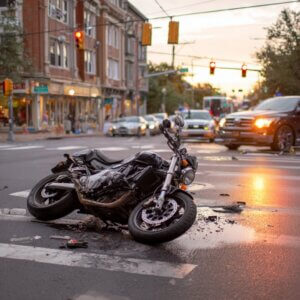 While helmet use may become a factor in calculating certain damages, it cannot prevent you from filing a claim entirely. The key focus of your lawsuit remains on proving the other driver’s negligence caused the crash.
- Your right to sue: Pennsylvania law allows you to pursue compensation regardless of helmet use.
- Fault determination: The at-fault driver remains liable for causing the accident.
- Damage limitations: Helmet status may only affect compensation for specific head-related injuries.
- Burden of proof: The defense must prove a helmet would have prevented your particular injuries.
How Does Pennsylvania’s 51% Comparative Negligence Rule Affect My Claim?
Comparative negligence is a legal rule that assigns fault percentages to each party involved in an accident. Pennsylvania follows a modified comparative negligence system with a 51% threshold.
This means you can recover damages as long as you’re found 50% or less at fault for the accident. If you’re 51% or more at fault, you cannot recover any compensation from the other party.
Your compensation gets reduced by your percentage of fault. For example, if you’re found partially at fault, your recoverable damages will be reduced in proportion to your assigned percentage of fault.
When Does Helmet Status Actually Matter?
Helmet use only becomes relevant for injuries that helmets are designed to prevent. The defense can only argue for reduced compensation on specific types of injuries.
Injuries potentially affected by helmet status:
- Traumatic brain injuries and concussions.
- Skull fractures and head wounds.
- Facial injuries and broken facial bones.
- Scalp lacerations and scarring.
Injuries not affected by helmet status:
- Broken arms, legs, ribs, or other bones.
- Spinal cord and neck injuries.
- Internal organ damage.
- Road rash on your body and limbs.
Does the Defense Have to Prove a Helmet Would Have Reduced My Injuries?
Yes, the burden of proof lies entirely with the defense. The at-fault driver’s insurance company cannot simply claim your helmet absence caused your injuries without providing credible evidence.
Our experienced motorcycle accident lawyers in Philadelphia, Pennsylvania counter these arguments using medical experts and accident reconstruction specialists. These professionals analyze crash dynamics, injury patterns, and medical records to determine whether a helmet would have made any difference in your specific case.
The defense must prove with reasonable certainty that wearing a helmet would have prevented or lessened your exact injuries. General statements about helmet safety are not sufficient legal proof.
What Evidence Best Protects an Unhelmeted Rider’s Claim?
Strong evidence showing the other driver’s fault is your best protection against helmet-related defenses. The clearer the other party’s negligence, the harder it becomes for insurers to shift blame to you.
Immediate evidence preservation is critical because crucial proof disappears quickly after accidents. At Wilk Law Personal Injury & Car Accident Lawyers, we recommend gathering these key pieces of evidence:
- Police reports: Official documentation of the accident scene and initial fault assessment.
- Scene photographs: Pictures of vehicle positions, skid marks, traffic signals, and road conditions.
- Witness statements: Contact information and accounts from people who saw the crash.
- Medical records: Documentation linking your injuries directly to the accident.
- Motorcycle damage: Physical evidence showing impact forces and crash severity.
What Are My Next Steps to Build a Strong Case?
Your actions immediately after the accident can significantly affect the success of your claim. Seek medical attention right away, even if you feel fine initially, as some injuries don’t show symptoms immediately.
Avoid speaking to the at-fault driver’s insurance company without legal representation. Their adjusters are trained to get statements that minimize their company’s liability and your compensation.
Document everything related to your injuries and recovery, including medical appointments, symptoms, and expenses. Contact our law firm as soon as possible to preserve evidence before it’s lost or destroyed.
How Do Insurers Use the Helmet Defense, And How Do We Push Back?
The helmet defense is an insurance company strategy to reduce payouts by arguing that your choice not to wear a helmet contributed to your injuries. This tactic attempts to shift responsibility from their insured driver to you.
Common insurance company arguments include:
- You assumed the risk by choosing not to wear a helmet.
- Your head injuries would have been minor with proper protection.
- You were negligent in not protecting yourself, even when legally allowed.
Our proven counter-strategies:
- Focus on the at-fault driver’s negligence as the primary cause.
- Use expert medical testimony to prove actual injury causation.
- Document all damages, not just head-related injuries.
- Prepare aggressively for trial to show we won’t accept lowball offers.
We know how to combat these tactics because we’ve successfully handled hundreds of motorcycle accident cases. Insurance companies often back down when they realize we’re prepared to fight for full compensation.
What Damages Can I Recover After a Pennsylvania Motorcycle Crash?
Damages refer to the money you can recover for losses caused by someone else’s negligence. These fall into two main categories: economic damages, which have specific dollar amounts, and non-economic damages, which compensate for subjective losses.
Economic damages include measurable financial losses such as medical bills (both past and future), lost wages and income, reduced earning capacity, motorcycle repair or replacement costs, and other out-of-pocket expenses related to your accident and recovery.
Non-economic damages compensate you for subjective losses that don’t have a specific price tag, including pain and suffering, emotional distress, loss of life enjoyment, scarring and disfigurement, and loss of consortium (the impact on your relationship with your spouse).
We work to identify every available insurance policy that might provide coverage. This includes the at-fault driver’s liability insurance and your own uninsured/underinsured motorist coverage if applicable.
Do Limited Tort and PIP Rules Apply the Same Way to Motorcycles?
No, motorcycle accidents often fall outside standard auto insurance rules. Limited tort is a Pennsylvania insurance option that restricts your right to sue for pain and suffering in exchange for lower premiums.
However, if you selected limited tort on your car insurance, it typically doesn’t apply when you’re injured on a motorcycle. This means you retain the right to seek full compensation including pain and suffering damages.
Personal Injury Protection (PIP) coverage, which pays initial medical bills regardless of fault, usually doesn’t cover motorcycle accidents either. Most injured motorcyclists rely on their health insurance and the at-fault driver’s liability coverage for medical expenses.
Who Must Wear a Motorcycle Helmet in Pennsylvania?
Pennsylvania has age-based helmet laws that determine when you must wear protective headgear. A helmet is a protective head covering that meets federal safety standards known as DOT compliance.
All riders and passengers under 21 years old must wear a DOT-compliant helmet at all times. Riders 21 and older can legally ride without a helmet if they meet specific requirements.
To ride helmet-free in Pennsylvania, you must be 21 or older and satisfy one of these conditions:
- Hold a motorcycle license for at least two consecutive years.
- Complete a state-approved motorcycle safety course.
What About Passengers, Learner’s Permits, and Autocycles?
The helmet requirements can get confusing in certain situations. Any passenger under 21 must wear a helmet, even if the motorcycle operator is over 21 and legally exempt from helmet use.
All riders with learner’s permits must wear helmets regardless of age. An autocycle is a three-wheeled motorcycle with a fully enclosed cab, and these vehicles are exempt from helmet requirements entirely.
Do I Still Need Eye Protection in Pennsylvania?
Yes, eye protection is mandatory for all Pennsylvania motorcyclists. This requirement exists separately from helmet laws and applies even if you’re legally riding without a helmet.
You must wear safety glasses, goggles, or other protective eyewear unless your motorcycle has an adequate windscreen. This law protects riders from debris, insects, and wind that can cause serious eye injuries or impair vision.
Experienced Motorcycle Accident Law Firm in Philadelphia, Pennsylvania
At Wilk Law Personal Injury & Car Accident Lawyers, we have extensive experience defending the rights of injured motorcyclists throughout Pennsylvania. We understand how insurance companies try to use helmet status against riders and know exactly how to counter their tactics.
Our approach combines immediate investigation with aggressive advocacy. We coordinate your medical care, build a strong case, and negotiate fearlessly with insurance companies that try to blame you for their insured’s negligence.
You shouldn’t face financial penalties for making a choice that was legally yours to make. We handle all motorcycle accident cases on a contingency fee basis, meaning you pay nothing unless we secure compensation for you.
Contact Wilk Law today for a free consultation. We’ll review your case, explain your rights, and start fighting for the justice you deserve immediately.
FAQs About Riding Without a Helmet in Pennsylvania
Is It Legal to Ride Without a Helmet if I’m Over 21?
Yes, riders 21 and older can legally ride without helmets if they’ve held a motorcycle license for two years or completed an approved safety course.
What Is the Penalty for Not Wearing a Helmet in Pennsylvania?
Violating helmet requirements typically results in a summary offense with a small fine, but this citation doesn’t automatically reduce your injury compensation.
Will a Helmet Citation Hurt My Personal Injury Case?
A helmet citation won’t destroy your case, but the defense will use it to argue you contributed to your head injuries through negligence.
Does Limited Tort in my car insurance limit my motorcycle claim?
Usually, no, limited tort selections on auto policies typically don’t apply to motorcycle accidents, preserving your right to sue for pain and suffering.
Do Motorcyclists Get PIP Benefits in Pennsylvania?
No, Personal Injury Protection coverage in auto insurance policies typically doesn’t extend to motorcycle accidents, leaving medical bills covered by health insurance and liability claims.
Should I Tell the Insurance Adjuster I Wasn’t Wearing a Helmet?
Never give statements to insurance adjusters without consulting an attorney first, as they’re trained to use your words to minimize their company’s payout.
Can a Passenger Sue if They Weren’t Wearing a Helmet?
Yes, passengers can file injury claims, but their compensation for head injuries may be reduced if they were legally required to wear a helmet and didn’t.
How Long After a Motorcycle Crash Can I File a Lawsuit?
You have two years from the date of the accident to file suit in Pennsylvania, but contacting an attorney immediately helps preserve crucial evidence that can disappear quickly.