

A dooring accident occurs when someone opens a vehicle door into the path of a cyclist, motorcyclist, or pedestrian, causing either a direct collision or forcing the rider to swerve dangerously into traffic.
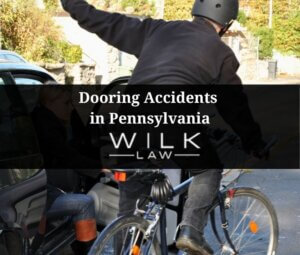 In Pennsylvania, opening a car door without checking for oncoming traffic violates state law under 75 Pa.C.S. § 3705, making the door-opener liable for resulting injuries and damages.
These accidents are particularly common in urban areas like Philadelphia, West Chester, and Pittsburgh, where narrow streets and heavy parking create dangerous “door zones” next to parked vehicles.
While cyclists face significant risks, motorcyclists often suffer more severe injuries due to higher speeds and greater impact forces when colliding with an opened door.
Most dooring accidents happen in these situations:
- Curbside parking: Someone in a parallel parked car opens their door without checking for bikes or motorcycles
- Rideshare drop-offs: Uber or Lyft passengers exit quickly without looking for cyclists
- Narrow city streets: You have little room to maneuver around a suddenly opened door
- Heavy traffic areas: Drivers and passengers are focused on getting out, not on checking for riders
Is Dooring Illegal Under Pennsylvania Law?
Yes, opening a car door into traffic is illegal in Pennsylvania. The law is found in Pennsylvania Vehicle Code Title 75, Section 3705.
This law says you cannot open any car door “unless and until it is reasonably safe to do so and can be done without interfering with the movement of other traffic.” This means everyone in the car – drivers and passengers – must check for cyclists and other vehicles before opening their door.
When someone violates this law and causes your accident, it proves they were negligent. This makes it much easier for you to win your injury case and get compensation.
Who Is at Fault in a Pennsylvania Dooring Accident?
The person who opened the car door is usually at fault for a dooring accident. But figuring out who pays for your damages can get complicated because different people might be responsible.
Here’s who could be liable for your injuries:
- The driver: If they opened the door, their car insurance typically covers your damages
- A passenger: Their homeowner’s or renter’s insurance might provide coverage when they cause the accident
- The car owner: They could be responsible if they let someone irresponsible use their vehicle
You can still recover money even if you never actually hit the door. If someone opens a door and you swerve to avoid it but crash into something else, the door-opener is still responsible for creating the dangerous situation.
How Does Pennsylvania’s Comparative Negligence Rule Apply?
Pennsylvania follows a 51% comparative negligence rule. This means you can still get compensation for your injuries even if you were partly at fault, as long as you’re less than 51% responsible for the accident.
If you’re found to be partially at fault, your compensation gets reduced by your percentage of blame. Under Pennsylvania’s comparative negligence rule, your compensation will be reduced to reflect your share of fault.
Insurance companies often try to blame you for dooring accidents by claiming you:
- Rode too close to parked cars: They’ll say you should have stayed further from the door zone
- Were going too fast: They’ll argue you couldn’t stop in time because of your speed
- Weren’t visible enough: They might claim you weren’t wearing bright clothes or using lights
- Were in the wrong position: They’ll say you should have been in a different part of the lane
Even if some of these arguments have merit, being partially at fault doesn’t prevent you from getting compensation. Our experienced Philadelphia personal injury attorneys can fight these tactics and protect your right to fair payment.
What Should I Do After a Dooring Accident in Pennsylvania?
The steps you take right after a dooring accident are crucial for your health and your legal case. Acting quickly and properly can make the difference between a successful claim and a denied one.
Seek Medical Care First
Get medical attention immediately, even if you think your injuries are minor. Some serious injuries like concussions or internal bleeding don’t show symptoms right away. Having medical records that link your injuries to the accident is also important for your legal case.
Call Police and Get an Incident Report
Contact the police to report the accident. An officer can document what happened and may give the door-opener a ticket for violating Pennsylvania’s door law. This police report becomes powerful evidence for your injury claim.
Gather Photos, Video, and Witness Information
Use your phone to take pictures of everything – the open door, your injuries, damage to your bike or motorcycle, and the accident scene. If anyone saw what happened, get their name and phone number. Witnesses can help prove the other person was at fault.
Exchange Insurance and Contact Information
Get the driver’s name, address, phone number, driver’s license number, and insurance details. If a passenger opened the door, make sure to get their information too. You’ll need this to file insurance claims later.
Avoid Recorded Statements
The at-fault person’s insurance company will probably call you asking for a recorded statement. You don’t have to give one, and you shouldn’t without talking to a lawyer first. Insurance adjusters often use these statements to reduce or deny your claim.
Preserve Evidence Quickly
Important evidence, such as surveillance footage from nearby businesses, is often deleted quickly within 30 days. A lawyer can send letters requiring people to save evidence and can request video footage before it disappears.
What Evidence Helps Prove a Dooring Claim?
Strong evidence is the foundation of any successful personal injury case. The more proof you have that shows the other person was at fault and that your injuries are serious, the better your chances of getting fair compensation.
Police Reports and 911 Audio
The official police report gives an objective view of what happened. The 911 recording can capture important details and admissions that people made right after the accident when emotions were high.
Photos, Videos, and Scene Documentation
Visual evidence is extremely powerful in court. Photos showing the door’s position, traffic conditions, and your injuries right after the crash can clearly demonstrate what happened and how serious the impact was.
Witness Statements and Surveillance Footage
Independent witnesses who saw the accident provide unbiased accounts that support your version of events. Security cameras from nearby businesses can offer undeniable proof of exactly how the accident occurred.
Medical Records and Treatment Documentation
Your complete medical file proves that your injuries were caused by the dooring accident and shows the full extent of your treatment. This includes emergency room visits, follow-up appointments, physical therapy, and any ongoing care you need.
Property Damage Evidence
To get money for your damaged bike or motorcycle, you need repair estimates or replacement costs. Don’t forget about damaged gear like helmets, clothing, or electronics – these can add up to significant money.
Who Pays After a Dooring Accident?
Multiple insurance policies might cover your dooring accident damages. Understanding which policies apply can help you get the maximum compensation possible.
| Coverage Type | When It Applies | What It Covers |
| Driver’s Auto Insurance | Driver opens the door | Medical bills, lost wages, bike damage |
| Homeowner’s/Renter’s Insurance | Passenger opens the door | Same coverage through personal liability |
| Your Uninsured Motorist Coverage | At-fault person has no insurance | Covers your damages when others can’t pay |
| Your PIP Coverage | Any dooring accident | Immediate medical bills regardless of fault |
| Rideshare Insurance | Uber/Lyft passenger doors you | Depends on driver’s app status |
Sometimes multiple policies apply to the same accident. Our skilled legal team at Wilk Law Personal Injury & Car Accident Lawyers can identify all possible sources of coverage and make sure you get money from each one that applies.
What Damages Can You Recover in a Dooring Case?
When you’re hurt in a dooring accident, you have the right to compensation for all the ways the crash has affected your life. Pennsylvania law divides these damages into two main categories.
Economic damages are the financial losses you can calculate with bills and receipts:
- Medical expenses: All your treatment costs, from the emergency room to physical therapy
- Lost wages: Money you couldn’t earn because of your injuries
- Future medical costs: Ongoing treatment you’ll need for your injuries
- Property damage: Cost to repair or replace your bike, motorcycle, and gear
- Reduced earning capacity: If your injuries affect your ability to work long-term
Non-economic damages compensate you for the ways your injuries have reduced your quality of life:
- Pain and suffering: Physical discomfort and emotional distress from your injuries
- Scarring and disfigurement: Permanent changes to your appearance
- Loss of enjoyment: Activities you can no longer do because of your injuries
- Mental anguish: Anxiety, depression, or trauma from the accident
Your ability to get non-economic damages depends on whether you have “Limited Tort” or “Full Tort” car insurance. Limited Tort policies restrict your right to sue for pain and suffering unless your injuries meet Pennsylvania’s definition of “serious injury.”
How Long Do I Have to File a Dooring Claim in Pennsylvania?
Pennsylvania gives you two years from the date of your accident to file a personal injury lawsuit. This deadline is called the statute of limitations, and it’s found in Pennsylvania law at 42 Pa.C.S. § 5524.
Missing this deadline means you lose your right to get compensation forever. Courts won’t hear your case if you file even one day late, no matter how strong your evidence is or how badly you were hurt.
Some situations can change your deadline:
- Government vehicles: If a city bus or government car caused your accident, you must give written notice within six months
- Minor victims: The two-year clock might not start until the injured person turns 18
- Hidden injuries: In rare cases where injuries aren’t discovered right away, the deadline might start when you discover them
Don’t wait to act on your case. Important evidence like surveillance video gets deleted quickly, and witnesses’ memories fade over time. The sooner you start your claim, the stronger your case will be.
Are Motorcyclists at Higher Risk in Dooring Crashes?
Motorcyclists face much greater dangers than cyclists in dooring accidents. Motorcycles are heavier and travel faster, which means the impact with a car door can be devastating.
Common motorcycle dooring injuries include:
- Ejection injuries: The force throws you from your bike into traffic or onto pavement
- Traumatic brain injuries: Even with a helmet, the sudden stop can cause severe brain damage
- Spinal cord damage: Landing wrong after being thrown can cause permanent paralysis
- Multiple broken bones: Ribs, collarbones, arms, and legs often break in these crashes
Pennsylvania doesn’t require all motorcyclists to wear helmets, but not wearing one doesn’t hurt your legal case. The person who opened the door is still responsible for your injuries regardless of your safety gear.
How Do Riders and Drivers Reduce Dooring Risk?
While you can’t prevent every accident, both riders and vehicle occupants can take steps to reduce dooring risks.
If you’re a cyclist or motorcyclist:
- Stay out of the door zone: Ride at least 3-4 feet from parked cars when possible
- Watch for occupied vehicles: Look for heads in driver seats and movement in mirrors
- Scan for rideshare activity: Uber and Lyft cars often stop suddenly for pickups and drop-offs
- Take the full lane when needed: Don’t squeeze between parked cars and traffic if it’s unsafe
If you’re a driver or passenger:
- Use the “Dutch Reach”: Open your door with your far hand, which forces you to turn and look back
- Check mirrors twice: Look for approaching bikes and motorcycles before opening
- Open slowly at first: Give approaching riders time to react if they see your door moving
- Teach children proper exit procedures: Kids should wait for adult permission before getting out
Skilled Philadelphia Personal Injury Law Firm
After a dooring accident, you need to focus on getting better while we handle the legal fight. At Wilk Law Personal Injury & Car Accident Lawyers, we take immediate action to protect your case.
We start by preserving crucial evidence before it disappears. Because security camera footage can be lost or overwritten, we act quickly to request it from nearby businesses. We also contact witnesses while their memories are fresh and send legal notices requiring the at-fault party to preserve evidence.
Insurance companies will try to contact you quickly after your accident. They want to get a recorded statement or a quick settlement before you understand the full extent of your injuries. We handle all communication with adjusters to protect you from insurance claim denials and prevent them from tricking you into saying something that hurts your case.
Our firm has recovered millions of dollars for injured cyclists and motorcyclists throughout Pennsylvania, including West Chester, Reading, Coatesville, and Pottstown. We work on a contingency fee basis, which means you pay us nothing unless we win your case.
Contact us today for a free consultation to discuss your rights and options.
Dooring Accident FAQs
Can I Sue a Passenger Who Opened the Door?
Yes, passengers can be held legally responsible for dooring accidents. Their homeowner’s or renter’s insurance policy typically provides liability coverage for injuries they cause away from home.
What if I Swerved to Avoid the Door and Hit Something Else?
You can still recover damages from the person who opened the door because their negligent act forced you to take evasive action. Pennsylvania law recognizes that the door-opener caused your accident even without direct contact.
Can I Get Pain and Suffering Money with Limited Tort Insurance?
Limited Tort policies only allow recovery for pain and suffering if your injuries meet Pennsylvania’s serious injury definition. This includes permanent impairment of body function, significant disfigurement, or death.
Does Homeowner’s Insurance Cover Passenger Dooring Accidents?
Yes, most homeowner’s and renter’s insurance policies include personal liability coverage that applies when the policyholder negligently injures someone away from their property.
What if the Person Who Doored Me Left the Scene?
Hit-and-run dooring accidents can be covered by your Uninsured Motorist coverage. To help preserve potential coverage, report the incident to the police promptly and review your insurance policy for any required reporting timelines.
Does Not Wearing a Helmet Hurt My Case?
Pennsylvania’s helmet laws only apply to certain motorcycle riders, and not wearing one doesn’t eliminate your right to compensation. The door-opener’s negligence caused your accident regardless of your safety equipment.
How Does Rideshare Insurance Work in Dooring Cases?
Uber and Lyft insurance coverage depends on the driver’s status in the app when the passenger doors you. Different coverage limits apply when drivers are waiting for rides, en route to pickups, or during trips.
When Should I Contact a Lawyer After a Dooring Accident?
Contact a personal injury lawyer as soon as possible after your accident. Quick action preserves evidence and protects your rights before insurance companies start their investigation tactics.